In progressv0.1.0a2 · Analysis shipped · Reference mastering shipped
WPAudio Engine
A professional, explainable audio analysis and intelligent mastering engine, written in modern Python.
What WPAudio Engine is
It is not an AI mastering black box.
Every decision WPAudio Engine makes answers three questions — what, why, and how. Not as a comment in the source, and not as a paragraph in a manual. Each answer carries the metric IDs it used, the thresholds it compared against, the confidence it had, and what it chose to protect at the cost of something else.
Mastering tools that work well tend to be either a cloud service you upload to and hope, or a chain of processors that will not tell you what they did. WPAudio Engine is an argument that an engine can make good decisions and account for them.
01
The pipeline
Five stages, with strict boundaries between them. Three are built, one is partly built, and one is an empty package with a name.
01/Built
Audio
Immutable buffer, loader
02/Built
Analysis Engine
Five analyzers, 39 metrics
03/Not yet built
Decision Engine
Milestone M2 — empty package
04/Partially built
DSP Engine
Reference mastering only
05/Built
Report Engine
HTML, JSON, CSV
One line through five stages. A built stage is a filled node joined by a solid segment; the partly built stage is a ring joined by a long dash; the planned stage is a quiet ring joined by a short dash. Each stage says its state in words above its name.
Analysis never modifies audio.
Decisions never analyze audio.
DSP never makes decisions.
Those are three of twelve rules the project holds itself to. The one that matters most for explainability is blunter: the “why” is not a comment — it is a test. A rule that cannot be asserted against a table of inputs and expected decisions does not ship.
02
Where it is today
Working
Five analyzers — level, integrity, spectrum, loudness, stereo
True peak measurement with 4× oversampling, per ITU-R BS.1770-4 practice
Album-level analysis: cross-track statistics and outlier detection
Mastering verification — original against master, with delivery checks
Engineering reference masters from a deterministic, documented recipe
HTML, JSON and CSV engineering reports
A command line for a track, an album, a comparison or a master
Not yet built
The Decision Engine — mastering intent, with evidence and confidence
A general DSP graph — today there are primitives, not a node system
Intelligent mastering end to end: the targets are still an engineer’s
Any graphical interface or plugin format
Tests passing
395
Branch coverage
95.98%
Runtime dependencies
3
Decision records
8
Ruff and strict MyPy clean. Python 3.12+, on numpy, soundfile and pyloudnorm — three runtime dependencies, deliberately.
A note on names: WPAudio Engine is the product. aurora is the code name and the Python namespace it was born in — the package is aurora-dsp and the command is aurora. WPAudio Engine is what it is called; import aurora is what the code says.
03
The interface
Not a mockup — the engine running locally, mid-session, on a track from Wings & Prayers. It analysed the file, mastered it to a stated target, then re-opened the written file from disk and checked its own work with a second, independent meter.
Every number on screen is measured, not simulated — the verification pass included, from a meter that shares no code with the mastering path. Built for the Studio's own mastering workflow. Not a hosted product, and nothing here is asking for a signup.
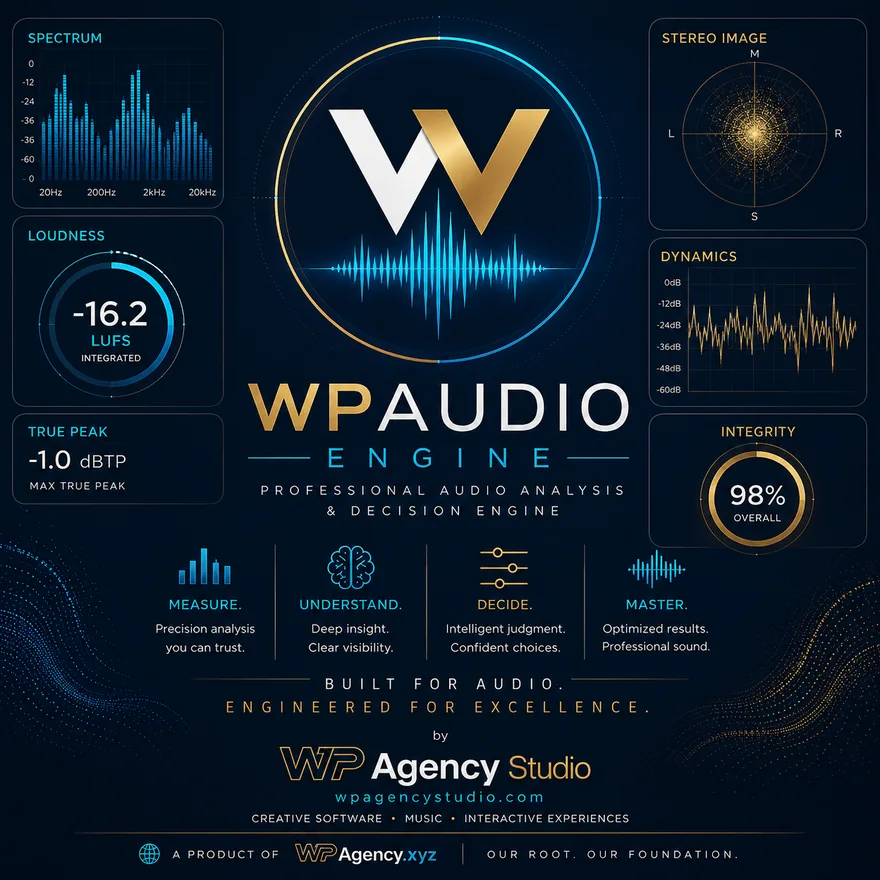
WPAudio Engine identity
The engine's identity graphic. The panels illustrate the measurement families the Analysis Engine covers; the readings shown in them are artwork, not output from a run. Real numbers from this engine are in the mastering case study.
04
Proved on a real record
Album-level analysis exists because another Studio project needed it. The twelve-track Wings & Prayers album was WPAudio Engine’s first real production workload — thirty-three minutes of finished masters, analysed end to end in seventy-nine seconds. Those reference masters have since shipped: the album was released on streaming platforms on 11 August 2026, byte for byte from the files this engine verified.
Running a real record through it surfaced things a synthetic test signal never would. The clearest: silence was reporting an integrated loudness of 0.0 LUFS — maximal loudness, the worst possible sentinel a loudness metric could pick. It now reports negative infinity, and the JSON exporter serialises non-finite values as null rather than emitting invalid JSON.
One project’s engine, mastering another project’s music. That is the whole studio thesis inside a single working directory.
The full story — every pre-master measured, every reference master verified, and the actual audio to A/B for yourself — is now a case study of its own.
A month later the same engine mastered the same songs again — the Second Flight record — to a different brief: one platform-reference level for every track, and every figure cross-checked by a meter from outside the project before it was published.
DropTrack's Music Analyzer scored Wings & Prayers: Second Flight between 94 and 97 out of 100. The full results, what the tool says the number is, and the line between a proprietary score and a measurement someone else can repeat.
The mastering case study forced a decision about evidence — quote the private engineering reports, or measure the published files. Choosing the second changed what the page could honestly say, and produced ADR 0007.