Written and engineered by WPAgency Studio
A Little More Sky Ahead
The Little Blue Pilot began as a picture book and a record. Since August it has gained a second record, films, flight notes, a place to ask questions and a workshop of things to make. How the parts were joined to each other, and where the world stands now.
In August, The Little Blue Pilot was two things you could hold. One was a picture book in fifteen illustrated chapters about a very small bird with a very big dream. The other was a record, Wings & Prayers, twelve songs released on 11 August 2026. They were made to sit side by side: six of the songs share a chapter’s name, and the book and the record tell one journey twice, neither of them a retelling of the other.
Two and a half months later the world around them is larger. There is a second record, a film and music videos, a shelf of flight notes, a page where a child can ask Little Blue a question, a workshop of things to make and print, a map, a hangar and a playroom. This entry is about how those parts were joined to each other, because the joining took more care than any one of them, and about what has deliberately not been added.
Two tellings, then pictures
Wings & Prayers: Second Flight followed on 11 September: the same twelve songs in new versions, in the same running order. The album proper was also published as a film, one continuous flight of about 24 minutes in eight chapters, from First Wings to Wingtips and Dew. Eleven music videos are now on the artist’s channel.
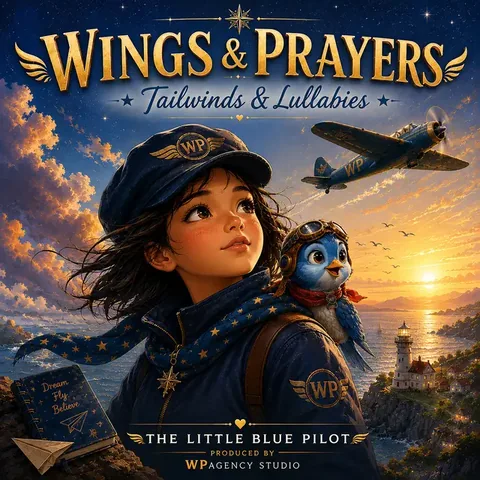
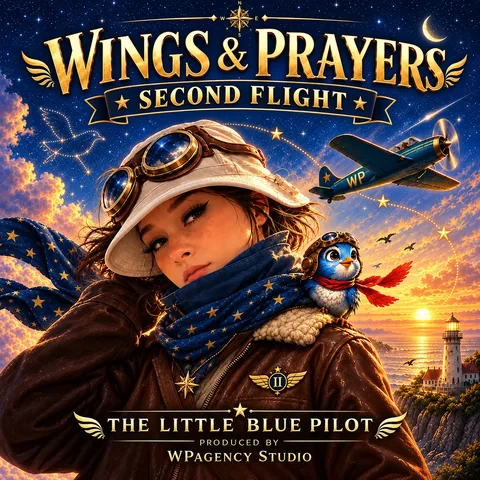
The two records: Wings & Prayers, 11 August 2026, and Wings & Prayers: Second Flight, 11 September 2026.
Each of those is a release of its own. A song in a video can run longer or shorter than it does on either record, and littlebluepilot.com says so plainly, rather than letting a reader assume that a video and a record are the same recording. Why there are two records of the same songs is its own story, told in Second Flight: Another Way to Fly.
The questions a story raises
A story about learning to fly raises questions about real flying, and the flight notes are where the site answers them: what a tailwind is, how a wing holds anything up, what a pilot does before take-off, why pilots watch the horizon, what turbulence is. Each note opens with a short version, takes as its headings the questions a reader would actually ask, keeps three words worth remembering, and closes with a section called “In the story”, where real flying and Little Blue’s world are set side by side and kept apart. The facts are checked against published sources, from the weather services to the aviation handbooks, and a sentence for a five-year-old is allowed to be simple, never wrong. The flight notes are still being reviewed and refined for scientific accuracy, readability and age-appropriate learning.
The Hangar does the same for the aeroplane itself: seventeen parts and five dials to press, each with a sentence for the child and a line for the grown-up, and a walk-around that ends with a card of its own to print. How it was sourced is in Nothing timed, nothing sent, nothing made up.
A place to ask
Ask Little Blue is where a child can put a question to the bird himself. There are 58 questions, in four topics a child already knows (Me and my friends, My story, My songs and How flying works), and each answer is a few sentences from the book, the songs or the flight notes, with the pages it came from underneath. It answers only the questions it was written to answer, on purpose, and the reason is written up in A Little Interactivity, Without a Chatbot.
Things to make and keep
The Workshop makes eight keepsakes in the browser for printing at home: a pilot card, a birthday card, a postcard, a little logbook, colouring pages, a junior pilot certificate, a reflection sheet and a boarding pass. A child’s name never leaves the device. A short journey of three small activities earns stamps that print on the keepsakes. There is a pilot’s logbook of seven sheets to print, colouring on screen, three picture games in which nothing is timed, and a departures board whose flights leave for the places on the map.
How the parts find each other
The Sky Map is the clearest picture of what the world has become. It is a chart of eight places on one loop. Each place opens its song, and a place’s card can lead further: the one for Home Airfield opens doors to the storybook, Ask Little Blue, the Workshop and the flight notes.
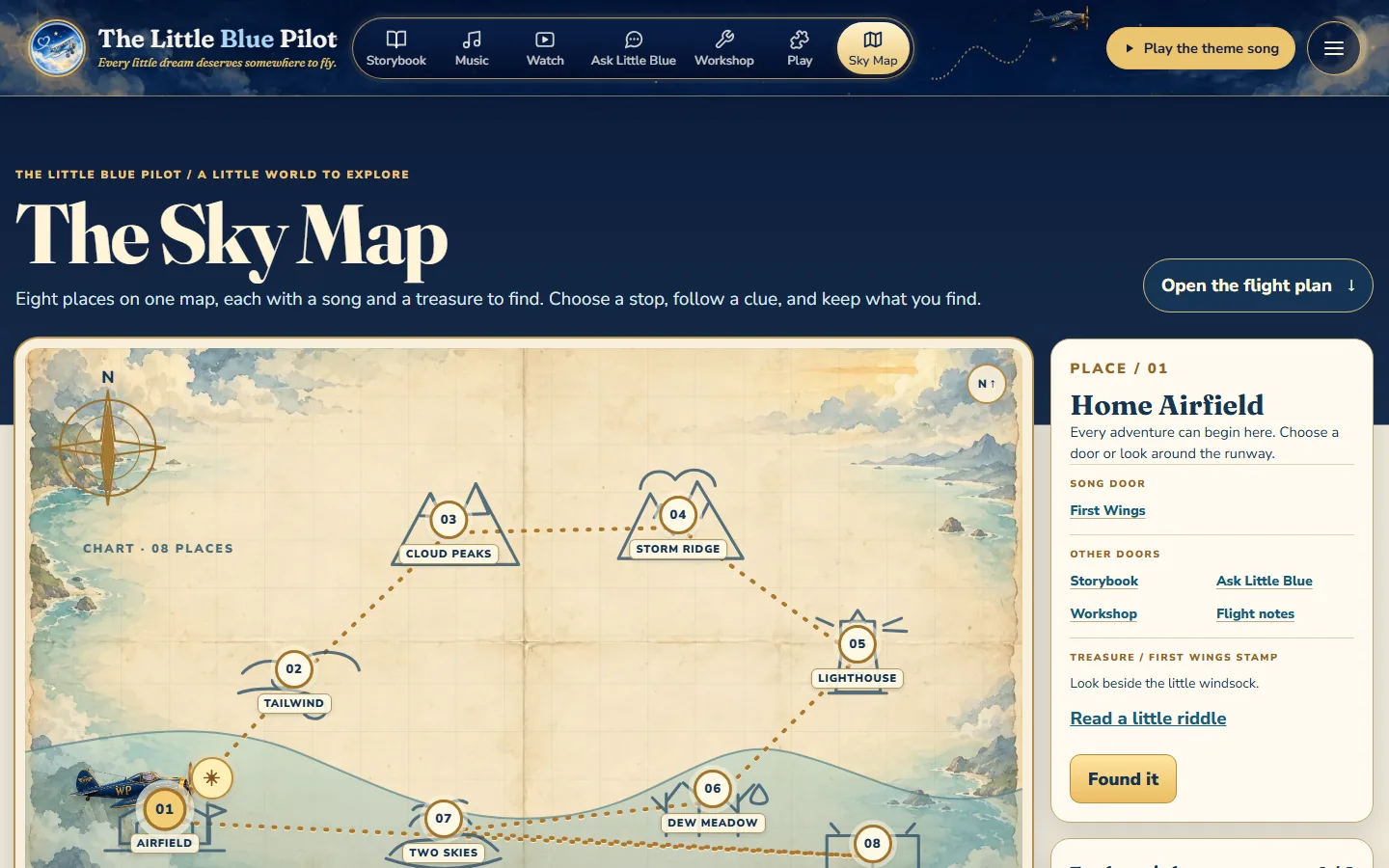
The Sky Map, 30 September 2026. Each of its eight places opens its song.
The same idea runs through every part of the site, and it is where most of the care went:
- Every chapter of the storybook links its songs and its flight notes, and the flight notes end where they began, in the story.
- A song belongs to a chapter only by a shared title, or by a dated decision of the owner’s. There is exactly one such decision so far, pairing Higher Than the Clouds with Chapter Eleven. A pairing made because a song simply feels right beside a chapter is refused when the site is built.
- Every answer in Ask Little Blue names the pages it came from, and every one of those links is checked against a real page.
- The logbook’s sheet of things every pilot knows is made from the flight notes, one question from each, so a new note reaches the printed sheet without anyone copying it there.
- The departures board flies to the Sky Map’s places, and its boarding pass is one of the Workshop’s keepsakes.
None of these links is decoration. Each one is a claim that two parts of the world belong together, and each is made only where the book, the songs or a decision on record supports it. That is what lets a child start anywhere, with a song, a question or a drawing, and find the rest.
What has not been added
The world is not finished, and some of what it lacks is deliberate. Nothing on the site is timed, scored or raced, and it remembers only two small things on the device: the places a child has found on the Sky Map, and the stamps from the Workshop’s journey. There is no account, no newsletter, no tracking and no person named anywhere on it.
Other gaps are simply not filled yet. A read-aloud script for the story, six scenes in which the music does most of the telling, is written and has never been recorded. And the Flight Cards this Journal named in September as the Workshop’s next step, cards that would remember what a child had earned, were not built.
Learning, slowly
The flight notes and the Hangar already teach real things, checked against real sources, to an age that deserves to be told the truth simply. Whether the same characters and scenes can help with other early learning is a fair question, and it is one the Studio means to answer slowly, by trying small things with families before saying anything about them. Nothing of that is built, and nothing of it is promised.
The storybook’s epilogue is called The Sky Is Still Open. For a world that is still being drawn, it is the right note to leave on.