Written and engineered by WPAgency Studio
Nothing timed, nothing sent, nothing made up
In the last week of September 2026, littlebluepilot.com grew from the home of a record into a place to ask, make, play and explore. Three rules shaped every part of it.
littlebluepilot.com is where The Little Blue Pilot lives: the storybook, both records and the films. Until the last week of September it was mostly somewhere to read, listen and watch. Now it is somewhere to do things as well. A child can ask Little Blue a question, make a keepsake, play three picture games, explore a map of his world, colour a drawing on screen, and find out what each part of his aeroplane does.
The one-line version of each is in Updates. This entry is about the rules underneath them. The site is for children aged 3 to 8, and designing for that age turned out to mean three rules more than any single feature: nothing hurries a child, nothing leaves the device, and nothing is said that a source cannot back.
Nothing is timed
A five-year-old does not play against a clock, and a game that punishes a slow answer teaches the wrong thing. The Playroom has three games (a picture puzzle, Memory Match and Find the Detail), and none of them is timed. There is no score to beat and nothing to lose. In Memory Match a pair that does not match stays face up until the next card is chosen, and Find the Detail waits for “Next detail”. The child sets the pace, including the pace of being wrong.
The same rule applies to motion. The home page’s stars and the remix pages’ clouds come to rest after a few seconds instead of moving for ever. The Sky Map scrolls like any page until the child chooses “Take controls”, so a map never captures a finger that only meant to scroll past it.
Reduced motion is treated as a way of showing the same thing, not as an off switch. In the Hangar, a reader who prefers less motion sees every moving part at both ends of its travel, side by side, and the engine says in words that the propeller is turning. The lesson survives; only the movement goes.
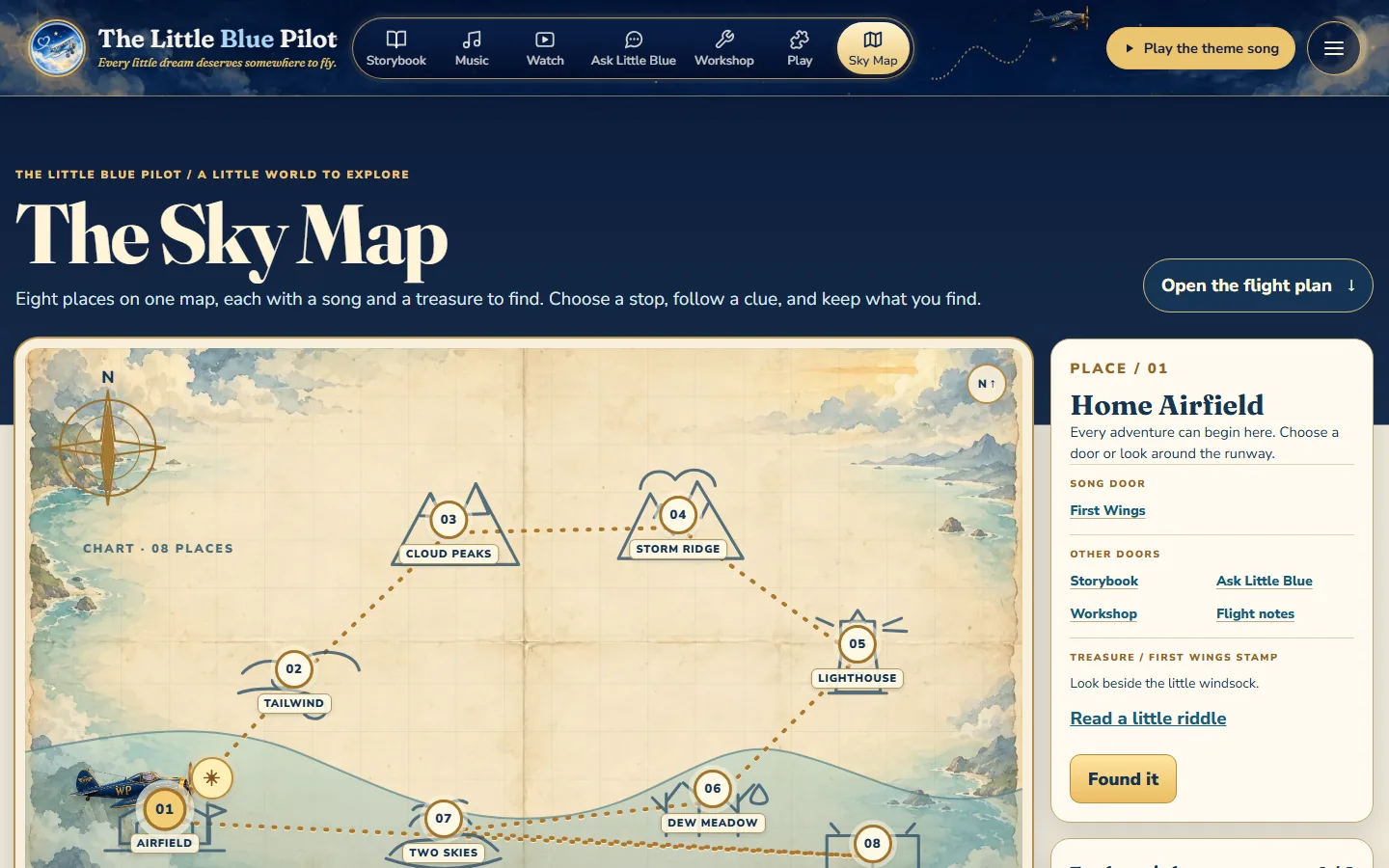
The Sky Map, 30 September 2026. The two chart paintings were made with an image-generation tool.
Nothing leaves the device
A children’s site should not need to know anything about the child using it, so the site asks for nothing. There are no ads, no trackers and no analytics.
Ask Little Blue looks like a conversation, and it is where this mattered most. It is not an open chatbot. A child picks a question from Little Blue’s own list, or types to find one on it, and the box searches that list and nothing else. Nothing typed is sent or kept. An answer can be read aloud, in a voice already on the device, and after one visit the page works offline.
The rest of the site follows the same pattern:
- The Workshop’s keepsakes (a pilot card, a certificate, a logbook cover, a colouring page and a postcard) keep the child’s name on the device. When a finished keepsake is shared, the picture is made in the browser and nothing is uploaded.
- The Sky Map takes its sky from the reader’s own clock, with no location asked for, and its explorer’s log stays in that browser until “Start a new adventure” clears it.
- The Share button opens the device’s own share sheet, or a row of plain links, with no code from any of those companies on the site.
- The Hangar and Colour It Here send nothing and store nothing.
Nothing is made up
The site’s facts come from three places: the author’s storybook and lyrics, the published releases, and, for the Hangar, the aviation handbooks. Each is treated as a source, not as material to improve. The author’s words are never changed, and where the site had drifted from its sources it was brought back: the album film tells the first eight songs of Second Flight, so it is “Eight songs, one flight” everywhere the site names it.
Ask Little Blue’s answers are written from, and checked against, the published storybook and songs, and a question that needs a grown-up leads to one.
The Hangar needed a different kind of source. It shows Little Blue’s aeroplane in a hangar, with 17 parts and 5 dials a child can press, and each card gives the part’s real name, one sentence a parent can read aloud, and a line for the grown-up. Every one of those was checked against the FAA’s Pilot’s Handbook of Aeronautical Knowledge, and where that handbook is silent, the card cites the one that is not. The pre-flight walk-around goes round the aeroplane the way the Airplane Flying Handbook describes: twelve checks, from the cockpit to the propeller.
Checking against a handbook mostly means leaving out the explanations everyone already knows. The rudder swings the nose but does not, on its own, turn the aeroplane; the tailplane pushes down, not up; and a wing does not fly because “the air goes further over the top”. A sentence for a five-year-old can be simple and still true.
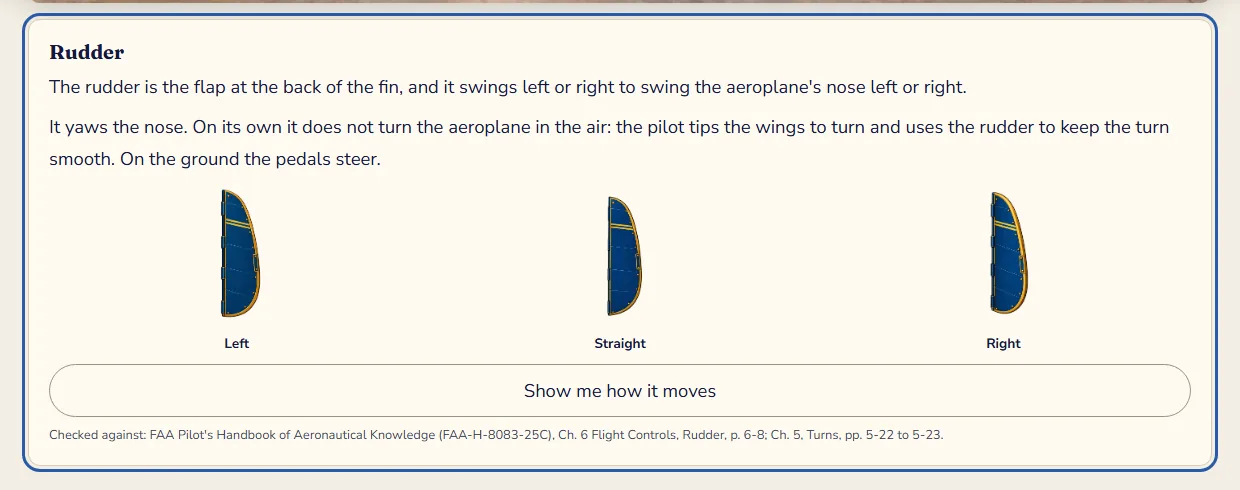
A part’s card in the Hangar: a sentence for the child, a line for the grown-up, both ends of the rudder’s travel, and the handbook section it was checked against. On a small screen the words are easier to read from the card at full size.
Built for small hands
Children tap imprecisely, and some use a keyboard or a screen reader. The Hangar is where this was hardest, because its buttons are parts of a painting.
Every part is a real button on the picture, and a keyboard reaches them from nose to tail. Every target is big enough for a small finger, and where two parts meet, the smaller one sits on top, so the fuel cap can still be pressed on the body of the aeroplane. On a phone the painting keeps its size and swipes sideways inside its own box, and the page itself never scrolls sideways. A chosen part is ringed in a thick solid line and the next walk-around check in a dashed one, so nothing depends on telling colours apart. The twelve crayons on the colouring page have names for the same reason: “Sky”, “Poppy red”, “Conker brown”.
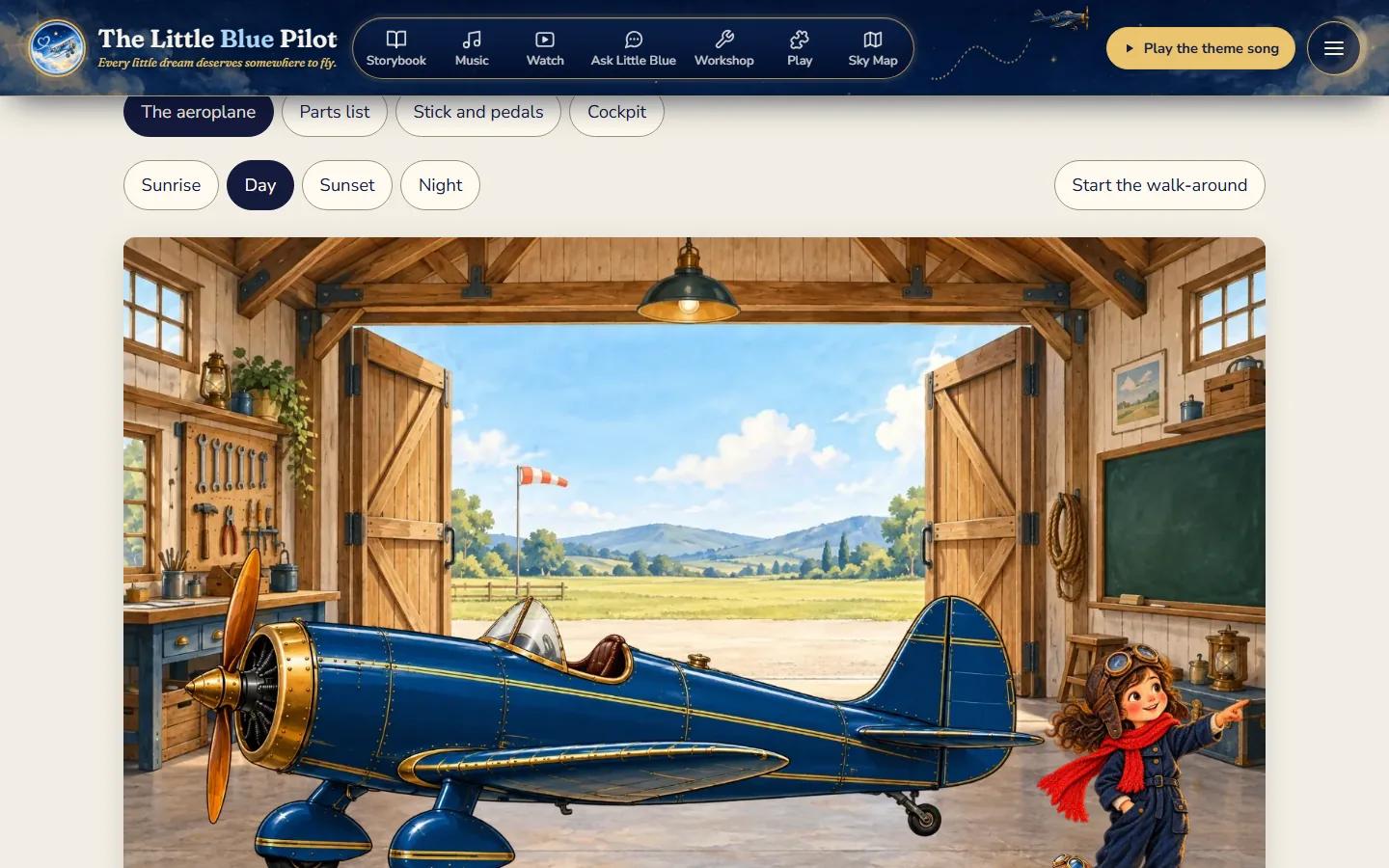
The Hangar, 30 September 2026. Every part of the aeroplane is a button.
Light enough for a slow phone
September’s finishing pass made the site lighter everywhere: across 39 pages, a phone now downloads about 9 MB less before the reader scrolls, and Lighthouse scored accessibility at 100 on every one of them. The Hangar, the heaviest new page, now shows its painting in about four seconds on a deliberately slowed phone connection, down from nearly nine.
What comes next
The Hangar and Colour It Here are the first part of a larger Workshop release. Next come Flight Cards, which will remember the cards a child has earned, starting with the Pre-flight Check card at the end of the walk-around.
Where to go next
- Try it: the Hangar, Colour It Here, the Sky Map, Ask Little Blue and the Playroom, on littlebluepilot.com.
- The world they belong to: Wings & Prayers, the project behind the records, the story and the game.
- The records: Second Flight, another way to fly, on flying the same twelve songs twice.
- The Studio’s rule on evidence: Publish only what you can measure.